


Pickleball has been gaining popularity as a recreational and competitive sport among communities across the United States. It is a fun and easy activity for adults of varying fitness levels, including beginners and those interested in trying something new.
So, how do you get started with pickleball? What do the rules entail? And what essential beginner equipment do you need?
Though pickleball has been around for a long time, it’s become even more popular in recent years. There are several pickleball leagues in Harrisburg if you want to join a group to help you improve your game and meet new people. You can also play solo or with a few friends for a low-commitment activity.
Let’s dive into the basics of pickleball for beginners with this guide.
Pickleball is an easy paddle sport that combines elements of tennis, table tennis (ping-pong) and badminton. It is played on an indoor or outdoor pickleball court with a net, paddle and plastic ball. The game can be played socially or more competitively, depending on what kind of activity you’re looking for and how much exercise you want to get while you compete. Pickleball is low-impact, putting less strain on the joints. This makes it a great sport to try as a beginner, no matter your age.
Pickleball and badminton courts are roughly the same size and are divided into two halves with a net. Compared to tennis, service boxes on pickleball courts are farther away from the net. Another big difference between tennis and pickleball is that the latter has a no-volley zone, also known as “the kitchen,” on either side of the net.
Much like tennis, pickleball can be played with two or four players and is based on a few straightforward rules that make it easy to follow. It involves hitting the ball repeatedly over the net until either of the parties reaches 11 points. To win the set, your team must lead by 2 or more points.
The serving player starts on the baseline on the right side of the court. They serve the ball toward the opposite corner of the court in a diagonal, underhanded motion from at or slightly below the waist. They can choose to drop or bounce the ball when serving.
The ball must bounce once on the receiving side of the court before it is returned to the server. Similarly, the ball must bounce once on the server’s side before it is hit back to the opponent. This is often called the double-bounce rule, which means that the ball must bounce once on both sides of the court before you can start with volleys. The pickleball game commences after a bounce on either side of the court. The ball can be returned as a groundstroke or as a volley.
In single pickleball games, the server serves until they are at fault, in which case it’s the opponent’s turn. In double games, the server passes the ball to their teammate until both make a mistake. The opponent then takes over the serve until the process repeats.
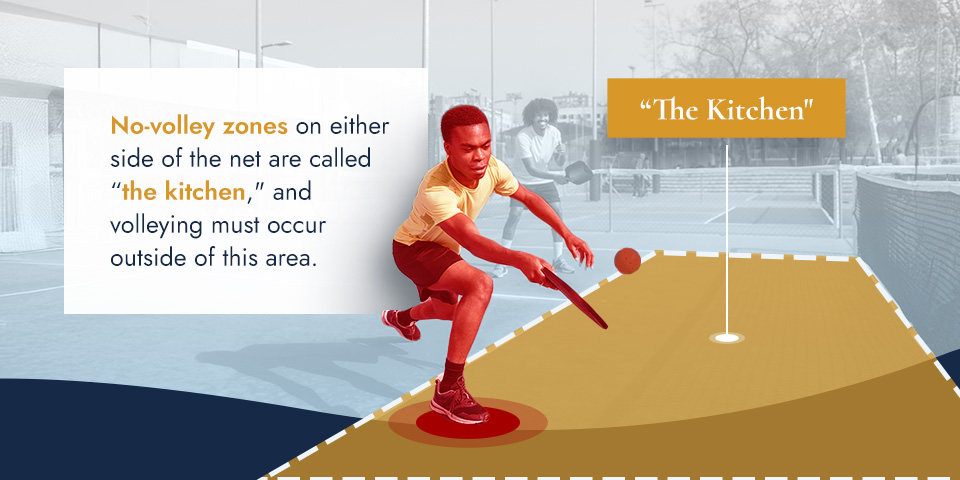
A volley is when you hit the ball in the air before it bounces. No-volley zones on either side of the net are called “the kitchen,” and volleying must occur outside of this area. No body part is allowed in the kitchen when hitting a volley, even if post-hit momentum forces you into the no-volley zone.
The kitchen rule applies to volleying only and prevents players from simply smacking the ball over the net. If the ball bounces and hits the ground, you may enter either of the zones whenever you like during the round. Players can also position themselves 1 to 2 inches behind the kitchen for a more competitive game.
Before every serve, the server calls out three numbers — the serving team’s score, the receiving team’s score and the server number. Points are scored by the serving team only. If the receiving team commits a fault, the serving team scores 1 point. In doubles, the players on the serving side will switch between left and right every time the serving team scores a point. Players on the receiving team never switch sides.
The game continues until the serving team reaches 11 points with a 2-point advantage. A match contains up to three games, and the winning team must win two out of the three. The third game is usually played up to 5 points with a 2-point advantage.
Any action that breaks one or more rules and hampers the game from continuing is considered a fault. Common examples include:
You do not need fancy equipment to play pickleball, making it an easy sport to explore at any given time and place. All you need to invest in is the following pickleball beginner equipment:
Are you ready to get started with pickleball at a court near you? This fun sport is based on straightforward rules and easily accessible equipment, and it can be enjoyed by anyone as a social or competitive activity. Don’t worry if you don’t have a strategy yet — come and have fun while you practice at Colonial Country Club, located in Harrisburg, Pennsylvania. If you believe you are a pro, challenge your opponents to a match and let the games begin. Become a member today to get started.